
Plastic waste is
harming livestock in South Africa: smallholder farmers using communal land set
out the support they need - Agriculture is the main
source of income for communities in rural Mpumalanga, in the
north-east of South Africa. Goats and cattle graze freely across open, communal
grasslands. But plastic bags, food wrappers, bottles and other plastic
materials have become part of this environment. When the dry season arrives and
fresh grass becomes scarce, hungry cattle and goats eat whatever they can find,
including the plastic waste. Linton Munyai, Nomcebo Madonsela, Mwazvita Dalu
and Tatenda Dalu studied how the environment responds to human disturbances. Their
latest research sets out how smallholder farmers’ livestock is
affected by plastic garbage and what can be done to solve the problem. Read more
Aquatic plants remove heavy metals from contaminated water bodies, says Biologists – Research work entitled "Enrichment and geo-accumulation of heavy metals in superficial sediments, macrophytes and edible leafy vegetables", secured Dr Elizabeth Kola a PhD in Biological Sciences from the University of KwaZulu-Natal (UKZN). Heavy metals pose a high risk to human health, aquatic life and ecosystem, explained Kola: "Most activities around aquatic areas discharge some material which contains heavy metals. Heavy metals tend to accumulate in water, sediments, aquatic organisms and even macrophytes. "To minimise heavy metal contamination in wetlands, it is very important to implement immediate measures to control industrial emissions entering the wetlands," she said. Read more
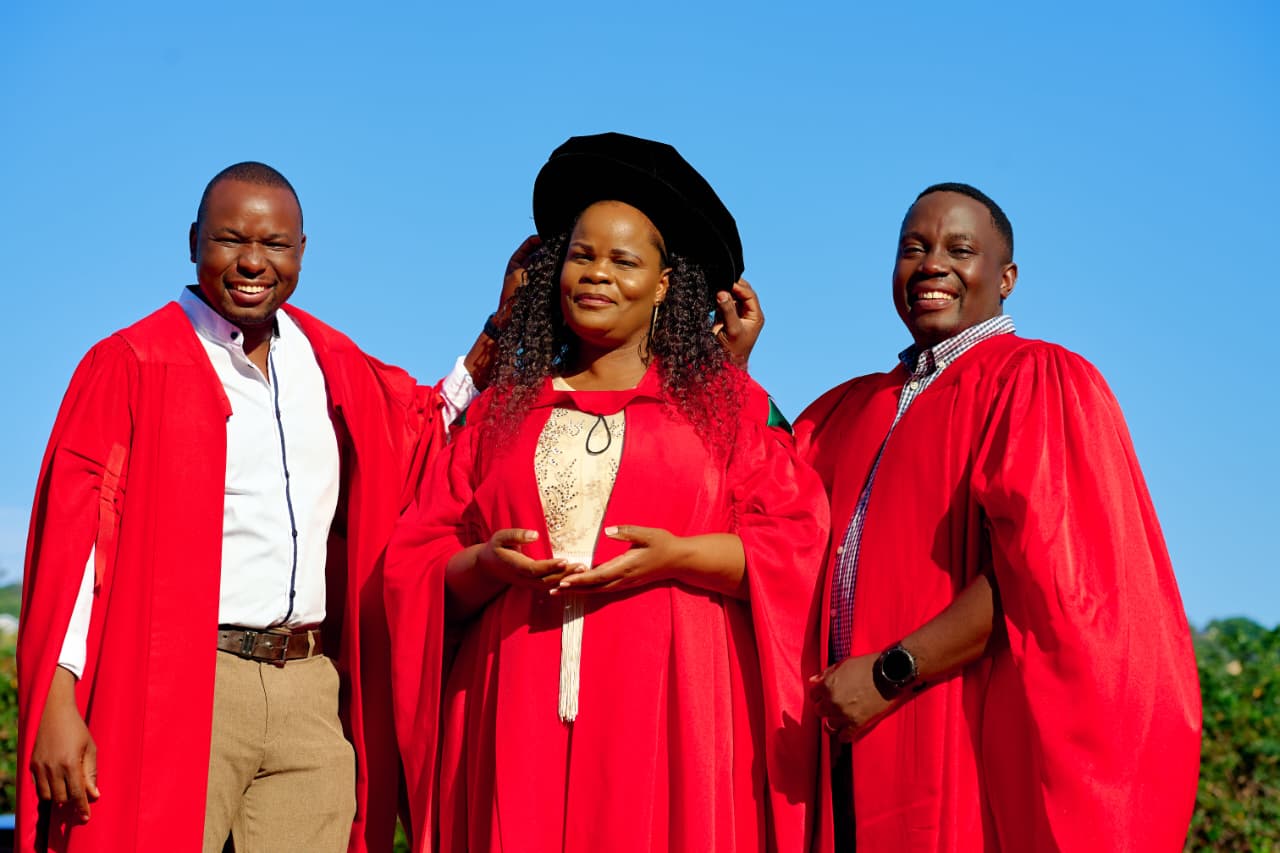
Centre for Invasion Biology welcomes new Director – The Centre for Invasion Biology (C·I·B) has named Professor Tatenda Dalu as its new Director, who started his role in December 2025. A seasoned academic and leading researcher in freshwater ecology and invasion biology, Prof Dalu’s research focuses how biodiversity reacts to environmental stressors such as invasive species, pollution, climate change, and land-use changes. His work uses field studies, biological monitoring, and applied science to understand how ecosystems work and to support their conservation and management. Prof Dalu joined the C·I·B from the University of Mpumalanga, where he established an internationally recognized research profile. Over the years, he has authored over 220 peer-reviewed articles on invasive species, freshwater biodiversity, ecosystem health, and environmental change — primarily within African landscapes. Read more
UMP celebrates its first PhD Graduate – Dr Khumbelo Mabadahanye, a dedicated scholar from the village of Tshikweta in Venda, Limpopo Province, became UMP's first PhD graduate - an accomplishment that reflects both individual determination and institutional growth. Her academic journey began at the University of Venda, where she completed a Bachelor of Science in Microbiology and Botany. She went on to earn an Honours degree in Botany at the University of Limpopo and Master's in Biotechnology at the University of Johannesburg. Read more

RIVER BIODIVERSITY AND HUMAN IMPACTS
SEMINAR – The University of Mpumalanga (UMP) Faculty of Agriculture and Natural
Sciences commenced the year with a seminar presented by Chinese Professor Prof
Naicheng Wu, focusing on Riverine Algal Biodiversity Under Changing Flow
Regime. Professor Naicheng Wu, a Full Research Professor at Ningbo University,
China, and Director of Physical Geography, discussed how human activities have
altered watershed flow regimes and degraded habitats. These changes have
precipitated a rapid decline in biodiversity, undermined ecosystem
functionality, reduced stability and resilience, and ultimately jeopardised
human well-being and the achievement of the United Nations Sustainable
Development Goals (SDGs). Read more
DR MUNYAI PRESENTS AT 9TH BRICS YOUNG
SCIENTIST FORUM – University of Mpumalanga (UMP) lecturer at the School of
Biology and Environmental Science, Dr Linton Munyai, showcased his research at
the 9th BRICS Young Scientist Forum and Young Scientist Congress held in Sochi,
Russia. Dr Munyai’s presentation highlighted the ecological significance of
wetlands, emphasising their role in supporting biodiversity and their
susceptibility to climate change. The Forum, organised by the Academy of
Science of South Africa (ASSAf) in collaboration with the Department of
Science, Technology and Innovation (DSTI), offers participants a platform to
share their work, explore potential collaborations, and engage in discussions
on science, technology, and innovation. Read more

Second Prize for Best Presentations - University of Mpumalanga (UMP) and Aquatic Systems Research Group Postdoctoral Research Fellow Dr Pule Mpopetsi who recently came second under the Postdoctoral Fellow Category at the recently held International Conference on Water and Environmental Sustainability (ICWES 2024) held in Richards Bay by the University of Zululand. Congratulations Dr Mpopetsi

PhD CANDIDATE PASSES WITH DISTINCTIONS - University of Mpumalanga (UMP) PhD candidate, Ronald Mashamba, recently graduated Cum Laude with a Master of Science Degree. Achieving an impressive 80%, Mashamba’s journey is a testament to his dedication and hard work, reflecting both his personal and academic growth. His research title: Assessing macroplastic abundance distribution and human perceptions towards plastic pollution in the Mvudi River System, Thohoyandou, South Africa. He was supervised by UMP Lecturers Dr Tatenda Dalu; Dr Mazvita TB Dalu and Dr Ross N Cuthbert from the Queens University Belfast, Northern Ireland. His research, which focused on the abundance, distribution, and perceptions of people towards plastic pollution along the Mvudi River system in South Africa, presented several obstacles. “I encountered difficulties in collecting data, especially macro plastics along the Mvudi River, interacting with the community, and analysing the data,” he explained that through perseverance, innovative problem-solving, and effective planning, he overcame these hurdles. Read more

UMP's reservoir facilitating innovative research – University of Mpumalanga (UMP) reservoir that quietly winds its way from the Earth Fill dam, meandering through the heart of the Mbombela campus, has captured the attention of BSc Honours Ecology student, Nozipho Madonsela to conduct her research investigating algal bloom. Madonsela's academic pursuit addresses a pressing global concern: water pollution. With the world grappling with the mounting challenge of securing clean and sufficient water resources, her focus centres on the reservoir. Here, she meticulously studies the fluctuations in algal biomass, intricately linked with the dynamics of nutrients. Having already achieved a BSc in Environmental Science, Madonsela's commitment is unwavering. She holds a strong interest in deciphering water quality intricacies and tracing pollution sources within freshwater ecosystems – an interest that fuels her drive for an in-depth BSc Honours research project. Read more

UMP and SANBI Advance Research Collaboration:
The University of Mpumalanga (UMP) is delighted to significantly advance its
research collaboration with the SA National Biodiversity Institute (SANBI). The
full SANBI Board and its Executive visited Mbombela Campus and had an
engagement dinner celebrating the multi-year, high-level joint futures on
research platform sharing, advanced capacity development, and focussed
research. Acknowledgments to the SANBI Chair and Deputy-Chair Prof Edward
Nesamvuni and Beryl Ferguson, CEO Shonisani Munzhedzi, Chief Director Prof
Ramagwai Sebola; and UMP Leaders Prof Funso Kutu, Acting Dean Agriculture and
Natural Sciences, Prof Dan Parker, Research Principal, Dr. Katherine Forssman
and Dr. Woudi Von Solms (Task team leaders), and outstanding MSc students: Aquatic Systems
Research Group student Elsie Nomcebo Leshaba and Lindokuhle Gumede. #DecadeofExcellence. Post from UniMpumalanga
Facebook Page
UMP recognises academic excellence. The awards are considered as an important mechanism to achieve the institution’s engaged vision, strategic goals and objectives, and to give recognition and reward for excellence in the performance of this core function. The key objective of the awards is to encourage excellence in engagement and an academic/scholarship-based model for engagement amongst emerging and established academics and support staff, and encourage research in engagement, and engaged research. Read more
UMP student living positively with disability. Ngomane was not born with a disability. Her story of triumph began shortly after graduating from high school. “I slept one night and woke up the next day unable to get out of bed; my entire right side (upper and lower limps) was paralysed. "I was hospitalized for several months and used a wheelchair while also going to therapy, which helped me to start believing in myself. I soon realised that I couldn't change the situation, but could live with it, that's when I decided to return to school and follow my dreams of becoming a nature conservationist.” Read more

Celebrating one of our very own ... Miss Nothando Nombuso Themba a Postgraduate Diploma student at the University of Mpumalanga and a member of Aquatic Systems Research Group (ASRG) has been selected to participate at the South African Institute for Aquatic Biodiversity, Makhanda, Eastern Cape Summer School 2022 running from the 5-8 December 2022 in Port Alfred, Eastern Cape Province of South Africa. The Summer School is for undergraduate (2nd and 3rd year) and postgraduate (Honours) students, who have an interest in continuing to post-graduate levels in the field of Aquatic Biodiversity. The numbers are limited to maximum of 10 applicants. Congratulations and represent us well. Read more
Water scarcity poses significant health hazards for Mpumalanga communities: South Africa is experiencing a water shortage and this in addition to the acid mine drainage challenges, present a significant threat to human health. Mpumalanga communities are at the risk of contracting waterborne diseases from streams that are poisoned by acid mine drainage and toxic chemicals, says University of Mpumalanga lecturer, Dr Tatenda Dalu. Dr Dalu, who has experience in aquatic ecology, environmental quality monitoring, biodiversity and conservation, says creating a global science-policy interface platform should be a priority to ensure minimal to zero-emission of emerging contaminants to protect the health of freshwater ecosystems.
National Science and Technology Forum (NSTF) Awards 2022 Finalist: The University of Mpumalanga’s Dr Tatenda Dalu was nominated as a finalist for 2021/2022 NSTF-South 32 Awards as a recognition of his outstanding contribution to science, engineering, technology (SET) and innovation in SouthAfrica. Dr Dalu was nominated for two categories namely: TW Kambule-NSTF Award:Emerging Researcher and NSTF-Water Research Commission Award. Dr Dalu is recognised for his research and contribution towards achieving sustainable water management, knowledge generation and solutions with demonstrated leadership and impact. The University of Mpumalanga congratulates and is proud of Dr Dalu’s research achievements in pursuit of our Vision of being An African University leading increasing opportunity for sustainable development through innovation. As a new University, UMP has identified research focus areas that are linked to one or more Sustainable Development Goals and are of relevance to the Mpumalanga province, SouthAfrica, and the African continent.
Emerging Freshwater Pollutants: Water is an essential source of life and is one of the most vulnerable environmental compartments. Consequently, water pollution has become a matter of utmost interest and concern worldwide, including in South Africa.Polluted water, according to the World Health Organisation (WHO), is water of which the composition has been changed to the extent that it is unusable. It is toxic and not fit for human consumption or used for essential purposes like agriculture, and which also causes diseases like diarrhoea, cholera, dysentery, typhoid fever and poliomyelitis. Read more
Fundamentals of Tropical Freshwater Wetlands: From Ecology to Conservation Management, 1st Edition - November 18, 2021 (copyright 2022). [Editors: Tatenda Dalu, Ryan J Wasserman]. Fundamentals of Tropical Freshwater Wetlands: From Ecology to Conservation Management is a practical guide and important tool for practitioners and educators interested in the ecology, conservation and management of wetlands in tropical/subtropical regions. The book is written in such a way that, in addition to scientists and managers, it is accessible to non-specialist readers. Organized into three themed sections and twenty-three chapters, this volume covers a variety of topics, exposing the reader to a full range of scientific, conservation and management issues. Each chapter has been written by specialists in the topic being presented. The book recognizes that wetland conservation, science and management are interlinked disciplines, and so it attempts to combine several perspectives to highlight the interdependence between the various professions that deal with issues in these environments. Within each chapter extensive cross-referencing is included, so as to help the reader link related aspects of the issues being discussed. Get your own copy from ELSEVIER and other selected retail outlets such as Amazon, Lehmanns, Beck-Shop.de, Play.Google

Congratulations to our new ASRG Postdoctoral Fellow Dr Takudzwa Madzivanzira for winning the 2021 National Research Foundation Research Excellence Award for Next Generation Researchers. Dr Takudzwa Madzivanzira’s research focuses on the impact of non-native crayfish in sub-Saharan Africa. This is a particularly daunting area as invasive crayfish, while negatively impacting native species and ecosystems, also have a food value for regional communities. His work combines both blue-sky elements on the broad-scale nature of biotic invasion, as well as highly practical and tangible benefits, such as developing optimised catch methods. See NRF website for detailed information

SADC-GMI implements the Groundwater Dependent Ecosystems (GDEs) and Biodiversity in the Khakea/Bray Transboundary Aquifer. Groundwater plays an important role in sustaining below-ground and above-ground aquatic ecosystems. However, there is limited data that demonstrates the relationship between groundwater and Groundwater Dependent Ecosystems (GDEs) to inform the sustainable management of the GDEs. Biodiversity data specific for Groundwater Dependent Ecosystems is hardly available in the SADC region. There is a knowledge gap in the understanding of the dynamics of the integrity/sustainability of the GDEs and the variations in the Groundwater systems. Read more
Aquatic invasive species cause damage worth billions of dollars: First global study on economic costs of aquatic invasive species published. The global movement of goods and people, in its modern form, has many unwanted side effects. One of these is that animal and plant species travel around the world with it. Often they fail to establish themselves in the ecosystems of the destination areas. Sometimes, however, due to a lack of effective management, they multiply to such an extent in the new environment that they become a threat to the entire ecosystem and economy. Thousands of alien species are currently documented worldwide. A quarter of them are in highly vulnerable, aquatic habitats. Read more about story
Why the Kruger Park is demolishing artificial water sources: Years of artificial water sources in the park have led to a number of ecological problems and landscape degradation. Strategically placed boreholes to cope with fluctuating rainfall patterns were first constructed in the Kruger National Park (KNP) as early as 1927. Now it is a programme the park is seeking to destroy. This is because scientists and conservationists have discovered that years of artificial water sources in the park have led to a number of ecological problems and landscape degradation. The project began in 1930, continuing until 1990. Boreholes, water troughs, concrete reservoirs and dams were constructed throughout the park to ensure all animals had access to water. Read more about project

FEATURED ARTICLE: A new species of copepod collected near Grahamstown has just been described (see published article by Saurez-Morales, Wasserman, Dalu 2015 in Crustaceana. Despite Grahamstown being a hotspot for Southern African aquatic biodiversity research, this little crustacean had managed to fly under the radar and avoid attention until recently. In June 2014, research collaborators from South African Institute for Aquatic Biodiversity (SAIAB) and Rhodes University collected copepods from a temporary (ephemeral) pond on a farm just outside Grahamstown. Immediately suspecting that the species had not been described, samples were sent to Dr Eduardo Suárez-Morales, a freshwater copepod specialist based at El Colegio de la Frontera Sur in Mexico. The copepod was identified as belonging to the group “Paradiaptomus” and the genus “Lovenula”. The new species was named Lovenula raynerae Saurez-Morales, Wasserman, Dalu 2015, after Dr Nancy A Rayner for her outstanding contributions to the taxonomical knowledge of this particular group of copepods. Perhaps the most striking thing about Lovenula raynerae is its size (4 - 5 mm long). It is among the world’s largest freshwater copepods, and is likely the largest of all African copepods. See featured research on El Colegio De La Frontera Sur, South African Institute for Aquatic Biodiversity and Water Wheel Magazine (July-August Issue, 2015) websites for more information on the recently discovered biggest known African freshwater copepod Lovenula raynerae Saurez-Morales, Wasserman, Dalu 2015.